What Discovery Writing Actually Looks Like

What Discovery Writing Actually Looks Like

People ask me sometimes how much of Axiom Flux I had planned before I started writing it. The honest answer is: less than you’d think, and less than I expected myself, going in.

I always start a book knowing roughly where it ends, an emotional shape I’m writing toward, and a handful of beats I want to hit along the way. For AF, I knew Amaiy would end up transformed, that it would cost him something real, and that the book would close on an unresolved note pointing into the next one. That’s about it. Everything else, the actual shape of the middle, who he’d meet, what would go wrong, who wouldn’t make it. I found out the same way you’re finding it out: by reading it as I wrote it.

That’s a strange thing to admit as an author, because it makes it sound like I’m not in control of my own book. In a sense, I’m not, not in the way outlining writers are. What I am is present for it. When Amaiy grafted a Gibdon out of jealousy over Yeyi, I didn’t plan that scene three chapters in advance. I wrote up to the moment where he was hurt and humiliated and reaching for something, anything, that would make the ache stop, and the graft was just what was there. It felt true to who he was in that moment, so I followed it, and then I had to live with what it cost him for the rest of the book, the same as he did.

Yeyi’s death is probably the sharpest example. I didn’t sit down that day planning to kill her. But I’d written a culture where love is supposed to be freely given, where selfishness has real social consequences, and once she made the choices she made, and once the story showed me how little anyone around her actually valued her in that moment, the ending she got was simply where the logic of the world I’d built pointed. I felt it arrive more than I decided it.

I think this is the part discovery writing does that outlining sometimes struggles to: it lets the world’s own rules generate consequences you didn’t personally choose to inflict. I built Eyonimic culture to have real teeth around generosity and belonging. I didn’t build it thinking “and this is how I’ll punish a character later.” But once it existed, it had opinions about what should happen to someone who violated it. I just had to be honest enough to let it.

The tradeoff is that I don’t always know what I’m handing my future self. Amaiy’s Assumption with Mozhe was written the same way the Gibdon graft was, fast, impulsive, barely examined. and only after I’d written it did I realize I’d repeated the exact same pattern I’d already put him through once. I hadn’t planned that echo. I found it days later, rereading, and had to decide whether it was an accident worth fixing or a truth about him worth keeping. I kept it. Sometimes discovery writing hands you a theme you didn’t know you were building until it’s already there, staring back at you.

If you’re a discovery writer too, or thinking about becoming one: the thing nobody tells you is that it’s not less work than outlining. It’s the same work, just paid on a different schedule. You don’t spend it up front deciding what happens. You spend it constantly, chapter by chapter, asking “given everything true so far, what would actually happen next,” and then having the nerve to let the answer stand, even when it’s not the answer you would have picked if you’d been asked in advance.
Designing a Culture Where Love Isn’t Exclusive

Designing a Culture Where Love Isn’t Exclusive

One of the things I knew early about the Eyonimics, the species at the center of Axiom Flux, is that they don’t love the way humans  or Amaiy’s own people, the Yatomites, do. Eyonimic love is communal. Polyamorous by default, not as a subversion of a “normal” monogamous baseline, but simply as how the culture works. Nobody in Eyonim is scandalized by it. It’s not a taboo being pushed against. It’s just Tuesday.

That was a deliberate choice, and it came with a harder design question than “let people love more than one person.” The harder question was: what keeps a culture like that from falling apart? If love is freely given and nobody’s bound to exclusivity, what stops it from just being chaos, or worse, a system where the loudest and most charismatic people hoard affection and everyone else goes without?

The answer I landed on was that Eyonimic love needed real consequences for being taken for granted. Daimun says it plainly at one point: we give free, we receive free. That’s not just a nice sentiment, it’s load-bearing. Generosity is the currency. And the flip side of that currency is that selfishness, taking love without reciprocating it, treating people as options rather than people, has a real cost. Not a moral lecture from a narrator. A social one. The community itself withdraws.

That’s what happens to Yeyi. She isn’t punished by fate or by any single character’s cruelty. She’s rejected by the actual mechanism the culture uses to keep itself healthy: when she treats Amaiy’s genuine, if imperfect, offer of Eyonimic love with contempt, the people around her stop extending grace, because that’s what the system is built to do to someone who won’t participate in good faith. I wanted that to feel less like punishment and more like a natural immune response, harsh, maybe, but not arbitrary.

I want to be careful about one thing, because I think it’s easy to misread: I didn’t write Eyonimic love to be better than the exclusive, monogamous love Amaiy grew up with as a Yatomite. It’s not a thesis that polyamory beats monogamy. It’s healthy for Eyonimics specifically, because it’s the structure that matches who they are and what they need from each other. Amaiy spends a lot of the book caught between two entirely valid frameworks for what love is supposed to mean, and he doesn’t fully abandon his Yatomite instincts even as he learns to live inside the Eyonimic ones. That tension is the point. I didn’t want either framework to win. I wanted them to sit next to each other and make each other more visible.

The thing I found most interesting to write, honestly, wasn’t the romance, it was the architecture underneath it. Assumption, the permanent bonding ritual Eyonimics use, isn’t just a nice ceremony. It’s genuinely irreversible, ending only in death, and it can be stacked in groups of three for real, tangible power, shared knowledge, deepened ability, a literal merging of consciousness. Love, in this world, isn’t just an emotional state. It’s infrastructure. It does things. That gave me a lot more to work with than “these two characters have feelings for each other,” because now every relationship in the book is also a structural choice with consequences attached, which, if I’m honest, is a pretty good description of what love actually is anywhere, once you look closely enough.

Every Scene Starts With a Date Nobody Asked For.

Every Scene Starts With a Date Nobody Asked For.

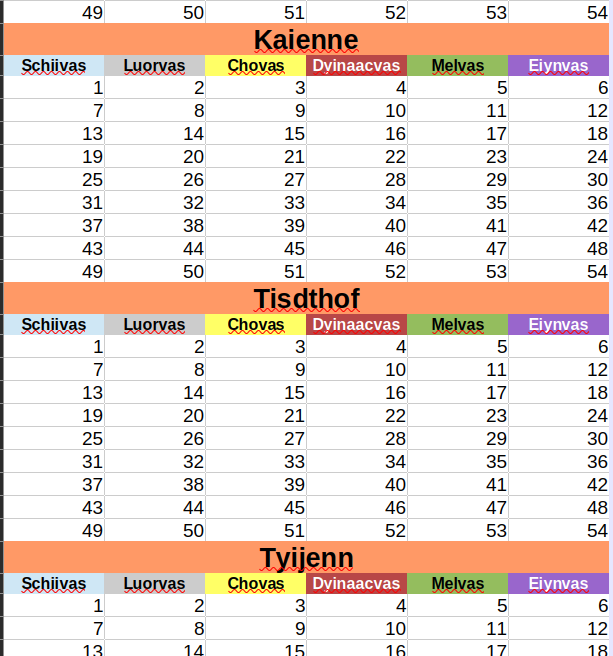
“Melvas 17th, Syvan, 8╥1071.”

That’s the first line of actual worldbuilding you get in The Rapture of Secrets, before a single character has said a word, and I will die on the hill that it’s doing more work than it looks like.

Why Bother With a Fake Calendar At All.

Here’s the thing about “it was a Tuesday” — it’s free. Everyone already knows what a Tuesday is. But “it was a Tuesday” also tells you literally nothing about the world you’re standing in. A made-up calendar costs you a little reader patience up front, sure, but it pays you back every single time, because it means the world was already running before page one and it’s going to keep running after the last page too. Nobody had to invent Syvan for my benefit. It was just… Tuesday, over there.

I’m not going to sit here and pretend I workshopped this technique like a genius. I just really like the aesthetic of a header that looks like it was stamped by a bureaucrat from another dimension. But it turns out that liking the aesthetic and it doing real narrative work aren’t mutually exclusive, so, hey. Win-win.

What It’s Actually Buying Me.

No exposition needed. I don’t have to stop the narrative to tell you time is passing, or that different chapters are happening in different places under a different sky. The header just tells you.

A sense of scale. “8╥1071” implies a very long history sitting behind this one scene, whether or not I ever explain the numbering system (I have not. I may never. You’ll live).

Texture for free. Different month-names (Syvan, Aszuul, Knapuani) sprinkled in without comment start to feel like seasons or regions the same way “October” does, even though you’ve never been told what any of them mean.

The Part Where I Almost Ruined It.

Funny enough, this is the exact same instinct that got me into trouble during the third draft — the one with the footnotes. I wanted so badly to explain the lore properly that I nearly buried the story under an appendix’s worth of context before the reader had earned any of it. The calendar header works precisely because it doesn’t explain itself. It’s a tiny, disciplined dose of “trust the reader,” sitting right at the top of every scene, and I had to relearn that lesson the hard way before I let myself actually use it right.

Small technique. Steal it if you want it.

Until next time.

~Shiri